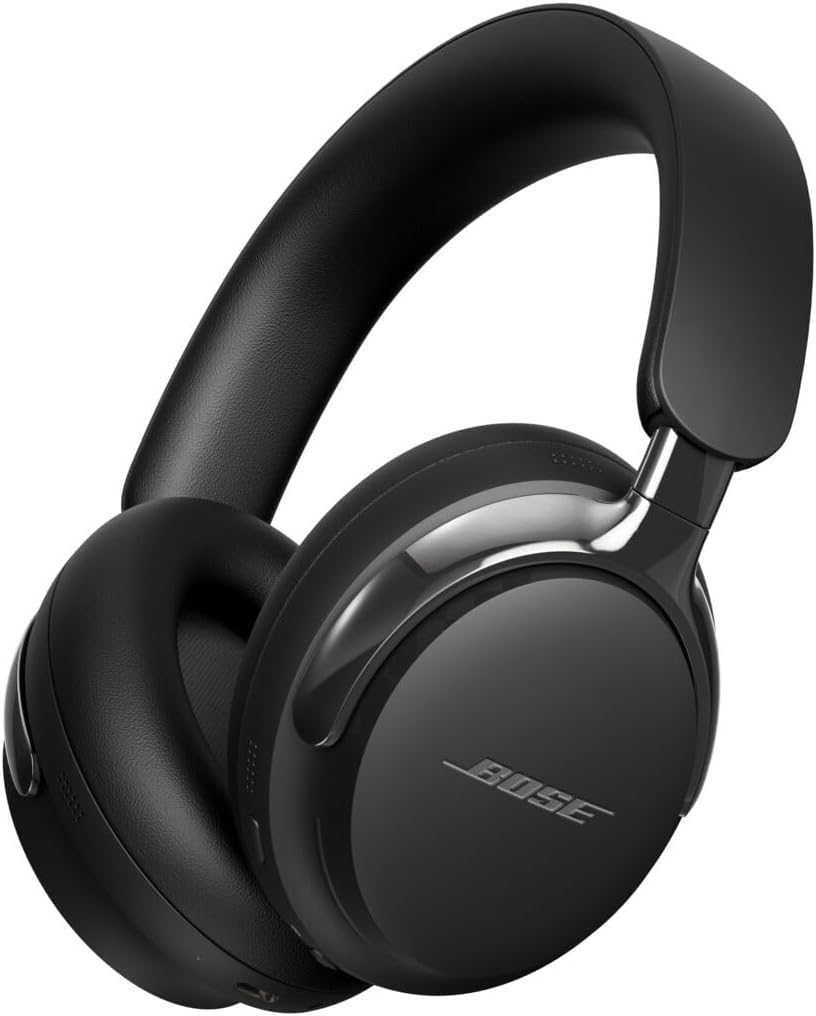
Bose QuietComfort Ultra Headphones (2nd Gen)
Why it stands out
- Outstanding independent ANC results
- Very comfortable fit
- Strong connectivity flexibility
Trade-off to consider
Premium positioning and shorter claimed battery life than Sennheiser.
Disclosure: If you buy through links on this page, ChoiceCheckLab may earn a commission at no extra cost to you.
Bose QuietComfort Ultra Headphones (2nd Gen) are the strongest overall choice for buyers prioritizing class-leading noise cancellation, comfort, and flexible wired or wireless listening. Sony WH-1000XM5 remain a capable travel-focused alternative with useful app controls and LDAC. Sennheiser MOMENTUM 4 stand out for long battery endurance and a smooth, warm presentation, while Beats Studio Pro offer the most accessible combination of USB-C audio, foldability, and Apple/Android convenience. These are editorial recommendations based on documented specifications and independent evidence, not ChoiceCheckLab hands-on testing.

Premium positioning and shorter claimed battery life than Sennheiser.

The non-folding earcups require more case space than compact-folding rivals.

Low-frequency ANC is not as strong as the leading travel-focused options.

No conventional Bluetooth multipoint, and comfort and microphone performance trail the leaders.
| Criterion | Bose QuietComfort Ultra (2nd Gen) | Sony WH-1000XM5 | Sennheiser MOMENTUM 4 | Beats Studio Pro |
|---|---|---|---|---|
| Model | 443987 | WH1000XM5/B | M4AEBT / 509266 | MQTP3LL/A |
| ANC | Adaptive ANC | Adaptive ANC | Hybrid adaptive ANC | Adaptive ANC |
| Transparency | Aware mode | Ambient Sound | Transparency mode | Transparency mode |
| Bluetooth | 5.4 | 5.2 | 5.2 | 5.3 |
| Codecs | SBC, AAC, aptX Adaptive on compatible devices | SBC, AAC, LDAC | SBC, AAC, aptX Adaptive | SBC, AAC over Bluetooth; USB-C profiles |
| Multipoint | Yes, two devices | Yes | Yes, two devices | No conventional multipoint |
| Wired / USB audio | Analog + USB-C audio | Passive 3.5 mm; USB charging | Analog + USB-C audio | 3.5 mm + USB-C audio |
| Battery claim | Up to 30 hr; up to 23 hr with Immersive Audio | Up to 30 hr ANC on; 40 hr off | Up to 60 hr with ANC | Up to 40 hr ANC off; 24 hr ANC on |
| Quick charge | 15 min for up to 3 hr | Manufacturer quick-charge support | 5 min for up to 4 hr | 10 min for up to 4 hr |
| Weight | Not specified here | Approx. 8.82 oz | Approx. 293 g | 260 g |
| Warranty | 1 year | 1 year | 2 years | 1 year |
| Where to buy | Check price on Amazon | Check price on Amazon | Check price on Amazon | Check price on Amazon |
Independent response and distortion evidence help describe tuning and consistency, but personal preference, seal, and EQ still matter.
Look beyond manufacturer language to independent performance across low rumbles, voices, and higher-frequency noise.
A useful ambient mode should make surroundings understandable without forcing the listener to remove the headphones.
Headband pressure, earcup depth, weight, heat, glasses, and head shape can matter more than small specification differences.
Separate manufacturer claims from independent endurance and consider ANC, volume, codecs, and spatial modes.
Call clarity depends on voice pickup and how well the system preserves speech around traffic, wind, or office noise.
Multipoint, codec support, stability, and ecosystem compatibility affect everyday switching more than Bluetooth version alone.
Analog and USB audio can extend device compatibility, but some headphones require power or restrict features in wired modes.
Reliable controls, EQ, ANC adjustment, firmware support, and device switching shape daily usability.
Folding design, case size, build, warranty, feature fit, and expected use matter more than the longest feature list.
Manufacturer documentation lists Bluetooth 5.4, multipoint, adaptive ANC, Aware mode, USB-C audio, analog input, and up to 30 hours of playback under stated conditions.
Independent testing supports superb noise isolation and high comfort, while the updated connectivity makes the model flexible across travel and desk use.
The premium price tier and shorter battery claim than Sennheiser reduce its value for listeners who do not need leading ANC.
Frequent travelers and office users who prioritize quiet, comfort, and flexible connectivity.
Sony specifies Bluetooth 5.2, SBC/AAC/LDAC, multipoint, Ambient Sound, analog listening, and up to 30 hours with noise cancelling enabled.
Independent testing supports strong ANC, useful microphone performance, and extensive app-based sound and listening controls.
The earcups do not fold inward, and the default warm tuning may need EQ for listeners seeking a leaner presentation.
Travelers wanting a mature feature set, LDAC, multipoint, and detailed app customization.
Sennheiser documents Bluetooth 5.2, SBC/AAC/aptX Adaptive, two active connections, USB-C and analog audio, and up to 60 hours with ANC.
Independent evidence supports very long endurance, a smooth warm presentation, comfortable wear, and strong general isolation.
ANC is less effective against the deepest low-frequency rumble than the strongest travel-focused competitors; seal changes can affect bass.
Listeners prioritizing battery life, sound personalization, and flexible wired and wireless listening.
Apple and Beats document Bluetooth 5.3, ANC, Transparency, USB-C audio, analog input, Apple/Android quick-pair features, and up to 40 hours with ANC off.
The foldable design, physical controls, cross-platform setup, and USB-C audio create a practical feature mix.
There is no conventional Bluetooth multipoint; independent testing finds comfort and microphone performance less competitive than the leaders.
Value-focused buyers who want foldability, USB-C audio, and convenient Apple and Android integration.
ChoiceCheckLab did not conduct original laboratory, listening, microphone, ANC, or battery testing for this comparison. The draft combines verified US manufacturer documentation, live exact-ASIN Amazon catalog identity, credible independent test evidence, and editorial analysis of comfort, connectivity, portability, and value trade-offs. Manufacturer claims are identified as claims; independent findings are paraphrased rather than presented as ChoiceCheckLab measurements.
Sound and comfort are partly subjective and can change with ear shape, head size, glasses, hair, source device, codec, and earcup seal. Manufacturer battery claims use controlled conditions and may not match daily use. Firmware and app features can change. Amazon availability can change. The Bose model is newer than the other three, while Sony WH-1000XM5 have been replaced at the top of Sony’s line but remain currently available. Evidence quality and test methods are not identical across every product.

Neither format is universally better. Over-ear headphones can provide stronger isolation, longer battery life, and more spacious earcups, while earbuds are smaller and easier to carry.
Bose QuietComfort Ultra Headphones (2nd Gen) receive the strongest ANC recommendation in this comparison, based on credible independent evidence. Fit, seal, and the type of noise still affect results.
Yes for buyers who value strong ANC, LDAC, multipoint, and a mature app. It is no longer Sony’s newest flagship, so compare its current availability and features with newer alternatives before buying.
No. Codecs can affect bandwidth, latency, and compatibility, but tuning, DSP, fit, source quality, and implementation also matter. A longer codec list does not guarantee better sound.
All four support a wired option, but behavior differs. Bose, Sennheiser, and Beats support USB audio as documented, while analog modes and power requirements vary by model.
Multipoint is useful when switching between a phone and computer. Bose, Sony, and Sennheiser support two-device use; Beats rely more on ecosystem switching and do not offer conventional multipoint.
Choose Bose QuietComfort Ultra Headphones (2nd Gen) when premium ANC and comfort are the priority. Choose Sony WH-1000XM5 for a balanced travel package with LDAC, multipoint, and detailed app controls. Choose Sennheiser MOMENTUM 4 when battery endurance, warm sound, and wired versatility matter more than the very strongest low-frequency ANC. Choose Beats Studio Pro for a foldable, value-oriented option with USB-C audio and convenient Apple/Android integration.